
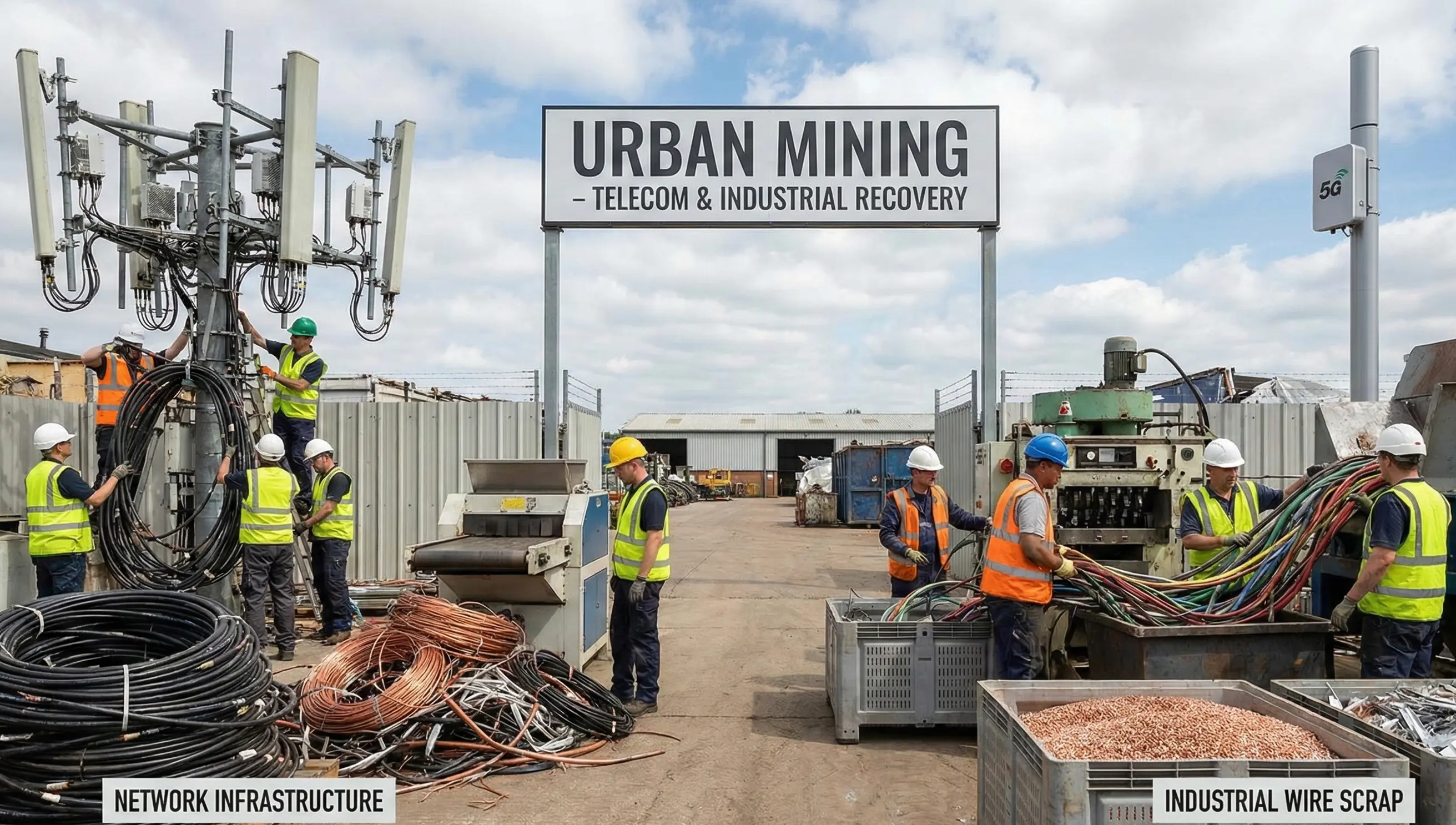


As telecom carriers race to deploy 5G and fiber-optic networks, they're retiring massive volumes of legacy copper infrastructure worth millions in recoverable metals. This is urban mining — and the companies that treat decommissioning as a revenue event instead of a cost center are leaving their competitors behind.
Right now, every major wireless carrier and landline operator in the United States is in some phase of network modernization. AT&T, Verizon, T-Mobile, and regional carriers are decommissioning legacy copper plant, shuttering central offices, swapping out 3G and 4G cell sites for 5G nodes, and replacing coaxial and twisted-pair runs with fiber-optic cable. Every one of those projects generates scrap — and not low-value scrap, either.
We're talking about tens of thousands of pounds of copper cable per central office decommission. Aluminum messenger wire and ACSR conductors pulled from aerial routes. Lead-acid backup battery banks from every cell tower and switching facility. Steel antenna housings, mounting hardware, and microwave transmitter assemblies. Precious metals — gold, platinum, palladium — embedded in PBX circuit boards, switching equipment, and connector assemblies.
This is urban mining in the truest sense: recovering high-concentration, high-purity metals from man-made infrastructure rather than extracting raw ore from the ground. And for the telecom companies, contractors, and industrial operators who understand how to manage this process, decommissioning isn't a cost center — it's a significant revenue generation opportunity.
Urban mining refers to the systematic recovery of valuable metals and materials from decommissioned infrastructure, end-of-life equipment, and industrial waste streams. Unlike traditional mining, which requires extraction from geological deposits, urban mining targets the concentrated metals already refined and installed in buildings, networks, and equipment.
The economics are compelling. A single central office decommissioning project can yield enough copper to represent six figures in scrap value. Multiply that across a carrier's entire legacy footprint, and the numbers become staggering. The same logic applies to industrial facilities retiring old wiring systems, automotive manufacturers processing end-of-life wiring harnesses, and utilities replacing aging ACSR transmission lines.
The challenge isn't whether the metal has value — it absolutely does. The challenge is whether the decommissioning process is managed in a way that actually captures that value instead of letting it leak through poor logistics, unqualified vendors, and below-market commodity pricing.
PBX system decommissioning and Main Distribution Frame removal represent the starting point for most telecom urban mining projects. Central offices — the physical buildings where telephone switching equipment lives — are being retired or repurposed as carriers transition to distributed architectures and cloud-based switching.
A typical central office contains massive Main Distribution Frames built from copper bus bars, terminals, and cross-connect wiring. Legacy PBX systems and digital switching equipment contain circuit boards with recoverable gold, platinum, and palladium. Power distribution systems include heavy copper bus, breaker panels, and battery backup systems. Cable vaults hold thousands of feet of copper trunk lines and distribution pairs.
The precious metal recovery opportunity from switching equipment alone — gold fingers on circuit boards, palladium in relay contacts, platinum in connector plating — can add meaningful value on top of the base metal recovery. Most carriers and their general contractors don't have the expertise or downstream relationships to capture this value, which is exactly where a qualified non-ferrous metal recovery partner changes the equation.
A properly managed central office decommission starts with a detailed asset inventory that identifies recoverable materials by type, estimated weight, and current commodity value. Equipment is de-installed systematically — switching gear separated from structural components, cable pulled and coiled for transport, batteries isolated and handled under hazardous materials protocols. The entire process requires chain-of-custody documentation, environmental compliance, and downstream processing partnerships that can actually deliver market-rate returns on the recovered material.
The outside plant — everything between the central office and the customer premises — is where the sheer volume of recoverable copper lives. Carriers have buried and aerial copper distribution networks spanning millions of route miles across the country, and as fiber-to-the-premises deployments accelerate, that copper is being retired.
Copper cable granulation is the process of mechanically shredding insulated copper cable and separating the copper from its plastic or rubber jacket. The output is 99% pure copper granules — sometimes called "copper chops" — which trade at or near COMEX copper pricing. The granulation process is dramatically more efficient than hand-stripping for high-volume recovery, and the purity of the output commands premium pricing from copper refiners and rod mills.
For telecom outside plant cable specifically, the copper content varies by cable type. Solid copper distribution pairs run around 40-55% copper by weight depending on jacket type and gauge. Trunk cables with larger gauge conductors can run higher. The key variable in maximizing return is processing efficiency — how much copper actually gets recovered versus lost in the separation process.
Aerial wire recovery involves removing copper and aluminum conductors from pole-line routes. This includes bare copper drop wire, insulated distribution cable, and aluminum messenger strand. Fiber optic de-installation is increasingly part of the same scope as carriers pull legacy copper routes and sometimes co-located fiber that's being replaced with higher-count cables.
The aluminum recovery from messenger wire and guy strand is often overlooked but meaningful at scale. Aluminum messenger wire is nearly pure alloy and trades well as clean aluminum scrap. Combined with the copper conductor value, a single aerial route removal project across a few hundred poles can generate substantial material value.
The wireless side of the equation is accelerating. 5G node upgrades require carriers to swap out existing radio equipment, antennas, mounting hardware, and backup power systems at tens of thousands of cell sites nationwide. Every swap-out generates scrap.
Antenna scrap recycling yields aluminum housings, copper RF connectors, and steel mounting brackets. Microwave transmitter removal produces waveguide assemblies (often brass or copper), outdoor units with recoverable circuit boards, and steel tower-mounted hardware. Backup power systems — particularly lead-acid backup batteries — require specialized handling due to hazardous material classification but carry meaningful commodity value.
Steel housings from equipment cabinets and antenna mounts represent the highest-volume material by weight, though lower per-pound value. The real margin comes from properly segregating and processing the non-ferrous components: copper, aluminum, brass, and circuit board precious metals.
Consider that the three major U.S. carriers collectively operate roughly 400,000 cell sites. A significant percentage of those are undergoing or scheduled for 5G equipment upgrades over the next several years. Even at modest per-site scrap values, the aggregate recovery opportunity across the wireless industry runs into hundreds of millions of dollars. The carriers and tower companies that build scrap value recovery into their upgrade project budgets — rather than treating it as an afterthought — are the ones capturing that value.
The urban mining opportunity extends well beyond telecom into industrial wire streams that generate enormous volumes of recoverable copper and aluminum.
Automotive wiring harness recycling processes the complex multi-conductor assemblies removed from end-of-life vehicles. A single vehicle contains 40 to 90 pounds of copper wiring, and with millions of vehicles reaching end-of-life annually, the aggregate copper recovery from harness recycling is massive. The challenge is efficiently separating copper conductors from the plastic connectors, tape wraps, and looming that make up the harness assembly. Granulation equipment designed for this specific application can achieve high copper recovery rates at production volumes.
ACSR wire stripping — Aluminum Conductor Steel Reinforced — targets the overhead transmission and distribution conductors used by electric utilities. ACSR consists of aluminum strands wrapped around a steel core, and the value is in separating those two metals cleanly. Stripped aluminum from ACSR commands strong pricing as a clean, identifiable alloy. The steel core has separate value as ferrous scrap. Utilities replacing aging transmission lines, upgrading capacity, or burying overhead routes generate significant ACSR volumes.
Romex scrap value comes from the copper building wire used in residential and commercial construction. When buildings are demolished or renovated, the NM-B ("Romex") cable pulled from walls and ceilings becomes a copper recovery feedstock. Romex typically runs 60-70% copper by weight, making it one of the higher-yield insulated copper wire types. For demolition contractors, electricians, and renovation companies, partnering with a processor who offers competitive pricing on Romex scrap can turn a disposal cost into a meaningful revenue line.
The difference between capturing full commodity value from decommissioned infrastructure and leaving money on the table comes down to a few key factors.
Mixed scrap gets mixed pricing — which means the lowest common denominator. A qualified processor will segregate copper by type and grade (bare bright, #1 copper, #2 copper, insulated), separate aluminum by alloy, isolate precious-metal-bearing circuit boards, and handle hazardous materials like lead-acid batteries under proper environmental protocols. Better segregation means higher per-pound returns across every material stream.
In-house granulation, shredding, and separation equipment — rather than brokering material to downstream processors — eliminates middlemen and their margins. Look for partners who own their processing equipment and can demonstrate throughput capacity, recovery rates, and quality control on the output.
Your scrap has a market value tied to published commodity indices — COMEX copper, LME aluminum, regional steel pricing. A trustworthy processing partner prices against these indices transparently, with clear weight documentation and settlement terms. If a vendor can't explain exactly how they're pricing your material relative to the market, that's where your margin is disappearing.
Telecom decommissioning and industrial wire recovery both involve materials that carry environmental liability — lead-acid batteries, PCB-containing capacitors in older equipment, mercury switches, and refrigerants in HVAC systems co-located at cell sites and central offices. Your processing partner needs demonstrated environmental compliance, proper permits, and documented downstream disposition for every hazardous material stream. Liability doesn't end when the truck leaves your site.
To put concrete numbers around the opportunity, here's what the major material streams look like at current market rates. These are approximate ranges — actual values depend on copper and aluminum commodity pricing at the time of settlement, material condition, and processing method.
Bare bright copper wire — the highest grade, clean and uncoated — trades in the range of $3.50 to $4.50+ as of per pound depending on market conditions. Insulated copper cable after granulation recovery yields value proportional to copper content, typically 40-65% of bare bright pricing depending on recovery rate and insulation type. Clean aluminum from messenger wire, ACSR strands, and equipment housings ranges from $0.60 to $1.10 per pound by alloy. Lead-acid batteries carry value of $0.15 to $0.30 per pound but require hazmat handling. Precious metal bearing circuit boards from telecom switching equipment are priced by assay, with values ranging from $2 to $15 per pound depending on board type and gold/palladium content.
For a carrier decommissioning a mid-size central office with a full copper cable plant, the total recoverable material value can easily reach $150,000 to $500,000 or more. A multi-site cell tower upgrade program across a metro area can generate $25,000 to $100,000 in aggregate scrap value. These aren't theoretical numbers — they're what our processing operations recover regularly for telecom clients managing active decommissioning programs.
Urban mining refers to the recovery of valuable metals — copper, aluminum, steel, gold, platinum, palladium — from decommissioned telecommunications infrastructure rather than traditional geological mining. Telecom networks contain concentrated, high-purity metals that can be recovered and returned to commodity markets at significant value.
A mid-size central office can yield tens of thousands of pounds of copper from Main Distribution Frames, cable vaults, trunk lines, and distribution wiring. The exact amount depends on the facility's size and the extent of the copper plant, but six-figure recovery values are common for full decommission projects.
Copper cable granulation is a mechanical process that shreds insulated copper cable and separates the copper from the insulation jacket. The output is 99% pure copper granules that command near-COMEX pricing from refiners. Granulation is far more efficient and consistent than hand-stripping for high-volume copper recovery from telecom and industrial cable.
5G node upgrades generate aluminum from antenna housings, copper from RF connectors and cabling, steel from mounting hardware and equipment cabinets, lead from backup batteries, and precious metals from circuit boards in radio equipment and microwave transmitters.
ACSR stands for Aluminum Conductor Steel Reinforced — the standard overhead transmission conductor used by electric utilities. Recycling involves stripping the aluminum strands from the steel core and selling each metal separately. The aluminum commands strong pricing as a clean, identifiable alloy, and the steel core has separate ferrous scrap value.
Romex (NM-B) building wire should be kept clean and separated from other wire types. At 60-70% copper content by weight, it's one of the higher-yield insulated copper streams. Granulation processing recovers the copper efficiently, and clean Romex lots command better pricing than mixed insulated wire.
Telecom decommissioning involves multiple regulated material streams including lead-acid batteries (hazardous waste), potential PCB-containing capacitors in older equipment, mercury switches, and refrigerants. Processing partners need appropriate environmental permits, documented hazardous material handling procedures, and verifiable downstream disposition records for all regulated materials.
Ask for transparent pricing tied to published commodity indices (COMEX copper, LME aluminum), certified scale weights, and material grading documentation. If your contractor can't provide clear pricing methodology and weight verification, the gap between market value and what you're receiving is their margin — not yours.
The telecom industry's network modernization wave and the ongoing replacement of industrial wire infrastructure represent one of the largest urban mining opportunities in the country. The carriers, utilities, and industrial operators who approach decommissioning as a commodity recovery operation — with proper material segregation, qualified processing partners, and transparent market-rate pricing — are turning what most companies treat as a disposal expense into a significant revenue line.
The metal in your legacy infrastructure has real, quantifiable value. The only question is whether you're set up to capture it or whether you're leaving it on someone else's table.
Feel assured collaborating with a certified professional.
Let's build a sustainable future together – get in touch for a consultation and take the first step towards responsible waste management.


