
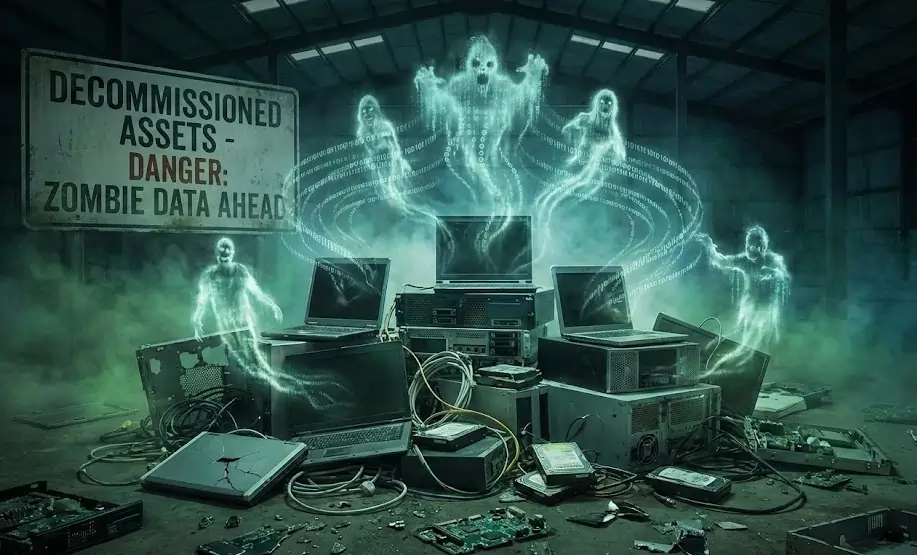


Morgan Stanley's $100 million penalty proved that zombie data—sensitive information lingering on decommissioned equipment—is one of the most expensive and overlooked cybersecurity threats facing enterprises today. Here's how to eliminate the risk before it eliminates your reputation.
When enterprise security teams build their threat models, they think about phishing, ransomware, and insider threats. Almost nobody thinks about the data sitting on decommissioned laptops, servers, and storage arrays that left the building months ago. That's exactly what makes zombie data so dangerous—and so expensive.
Zombie data is sensitive information that should have been destroyed during IT asset disposition but wasn't. It lives on drives that were assumed to be wiped, sitting in warehouses, secondary markets, or worse—listed for sale on eBay with recoverable customer records still intact.
In 2025, regulators, cyber insurers, and threat actors all agree: IT asset disposition data security is no longer a back-office logistics problem. It's a board-level risk with nine-figure consequences.
The most expensive example of zombie data exposure came from Morgan Stanley, which paid $100 million in combined penalties after customer data was discovered on servers that were supposed to be sanitized and recycled. This wasn't a sophisticated cyberattack. It was a failure of ITAD compliance requirements and vendor oversight.
The drives were handed off to a disposal vendor. That vendor subcontracted the work. Somewhere in that chain, verified data destruction never happened. Customer names, account numbers, and Social Security numbers survived on equipment that ended up in secondary markets.
This wasn't a banking-specific problem. Healthcare organizations, government contractors, legal firms, and any enterprise handling regulated data face identical exposure. If your organization generates data, you own that data—even after the hardware leaves your building.
According to the Global E-Waste Monitor, only 22.3% of global e-waste is formally recycled through documented, compliant channels. The remaining 77.7% disappears into informal markets, overseas brokers, and secondary resale channels with little to no oversight.
Independent investigations have repeatedly found used enterprise drives sold online containing recoverable customer data, login credentials, intellectual property, and financial records. Without proper e-waste data sanitization following standards like NIST 800-88, file deletion is cosmetic—not secure. A basic recovery tool can pull data from a "wiped" drive in minutes.
Once electronics cross international borders through resale chains, enforcing contracts, privacy laws, or data recovery becomes functionally impossible. Your data is gone, and your liability stays.
IBM's 2024 Cost of a Data Breach Report puts the average breach cost at $4.45 million. E-waste-related breaches frequently exceed that number due to the compounding effect of regulatory penalties, extended exposure timelines, and the difficulty of identifying exactly how much data was compromised.
Regulatory fines under frameworks like HIPAA, GDPR, CCPA, and SEC rules can reach into the tens of millions. Add legal fees, class-action settlements, forensic investigation costs, and incident response expenses—and the bill escalates fast.
The damage that doesn't show up on an invoice is often worse: loss of customer trust, executive accountability, board-level scrutiny, stock price volatility, and long-term brand erosion. For companies in competitive markets, a single ITAD failure can shift enterprise contracts to competitors overnight.
Cyber insurers in 2025 are asking detailed questions about IT asset disposition processes, chain-of-custody documentation, and certificates of destruction. Weak or incomplete answers can raise premiums significantly—or void coverage entirely when you need it most.
The gold standard for certified data destruction is NIST Special Publication 800-88, which defines three approved sanitization methods:
Clear — Logical overwrite techniques suitable for low-risk media being redeployed internally. This method uses standard read/write commands to overwrite data but may leave traces recoverable through advanced lab techniques.
Purge — Cryptographic erasure or degaussing that renders data unrecoverable through any known technique. This is the minimum standard for media leaving organizational control.
Destroy — Physical destruction through shredding, disintegration, or incineration. This is mandatory for failed drives, high-security media, and any situation where verification of software-based methods is impractical.
Software-based sanitization is acceptable only when properly validated against the specific media type and firmware. For enterprise environments with mixed media—SSDs, HDDs, NVMe drives, tape—physical destruction of end-of-life IT assets is often the only method that guarantees complete data elimination across all device types.
A legitimate certificate of data destruction includes asset serial numbers, the specific destruction method used, date and time stamps, location of destruction, and authorized signatures with chain-of-custody verification. Anything less than serial-level tracking is paperwork theater that won't hold up under regulatory scrutiny or legal discovery.
Your ITAD partner for data security must demonstrate certified data destruction capabilities with verifiable processes, maintain R2v3 or equivalent certification, prohibit unauthorized subcontracting, and provide full transparency from pickup through final disposition. The vendor's downstream chain is your liability—not theirs.
Every handoff point—from internal decommissioning to transport to processing to final destruction—must be logged with timestamps, responsible parties, and asset-level tracking. Gaps in chain of custody equal gaps in your legal defense.
Trust but verify—every single time. Conduct scheduled annual audits, unannounced spot inspections, and random asset verification against destruction records. The vendors who welcome this scrutiny are the ones worth keeping.
R2v3 certification integrates data security requirements directly into asset recovery and processing workflows, making it particularly relevant for enterprises prioritizing data destruction compliance for enterprise IT. e-Stewards certification emphasizes environmental controls and export restrictions. Both certifications matter, but neither replaces your organization's own oversight and verification program.
How do you verify data destruction was successful on each individual asset? Can you provide audit-ready reports with serial-level tracking? Who carries liability if data is recovered from equipment you processed? What downstream vendors touch our assets, and are they independently certified?
Vague answers about destruction methodology. Missing or inconsistent serial-level tracking. Resistance to on-site audits or surprise inspections. Subcontracting to uncertified downstream processors. Any vendor exhibiting these behaviors is a liability, not a partner.
$100 million — Total penalties paid by Morgan Stanley for ITAD failure. 62 million tons — Global e-waste generated annually, growing 3-5% per year. 22.3% — Share of global e-waste that is formally recycled and tracked. $4.45 million — Average cost of a data breach (IBM, 2024). 77.7% — Percentage of e-waste entering informal or untracked disposal channels.
Zombie data is sensitive information—customer records, credentials, intellectual property—that remains on decommissioned devices after disposal or recycling. It persists because drives were improperly wiped, verification was skipped, or vendors cut corners in the destruction process.
No. Standard file deletion and formatting do not meet e-waste data sanitization standards like NIST 800-88. Deleted data remains physically present on the drive and can be recovered with commercially available tools in minutes.
Certificates of destruction are not universally mandated by statute, but they are critical for demonstrating regulatory compliance and establishing legal defense in the event of a breach investigation. Most frameworks including HIPAA, SOX, and GDPR effectively require documented proof of secure data disposition.
Your organization retains ultimate responsibility for data protection through the full lifecycle, including disposition. Vendor failures are your failures in the eyes of regulators, courts, and customers.
At minimum, conduct formal audits annually with unannounced spot checks quarterly. High-volume enterprises or those in heavily regulated industries should increase frequency accordingly.
Only if proper controls, documentation, and chain-of-custody procedures are in place and demonstrable. Insurers are increasingly denying claims where ITAD processes were inadequate or undocumented.
Zombie data is silent, invisible, and extraordinarily expensive. The Morgan Stanley case proved that IT asset disposition data security failures can generate more financial damage than most cyberattacks.
The path forward is straightforward: follow NIST 800-88 standards, demand verified serial-level destruction documentation, treat ITAD as a core security function rather than a logistics afterthought, and partner with R2-certified processors who welcome transparency and accountability.
Your decommissioned hardware doesn't care about your intentions. It only cares whether the data was actually destroyed. Make sure it was.
Feel assured collaborating with a certified professional.
Let's build a sustainable future together – get in touch for a consultation and take the first step towards responsible waste management.


